
A Family Tree Written in DNA - The Abadi Branch
For years, I researched the Abadi family the traditional way: names, documents, gravestones, family stories, archival records, and relationships pieced together one generation at a time.
Then Y-DNA gave me another kind of family tree.
One written not in names, but in mutations.
And the more Abadi men who tested, the more that tree began to take shape.
What Exactly Is Y-DNA?
Y-DNA is passed from father to son along the direct paternal line. A father passes his Y chromosome to his sons, who can then pass it to their sons, generation after generation.
That makes Y-DNA particularly useful for studying paternal surnames such as Abadi, because in many cultures both the surname and the Y chromosome traditionally travel through the same male line.
Women do not inherit a Y chromosome, so I cannot take a Y-DNA test myself. But I can study my paternal line through close male relatives who descend directly from that same Abadi line.
For our research, we used FamilyTreeDNA’s Big Y test, which examines the Y chromosome for mutations known as SNPs — small genetic changes that can mark branches in the paternal family tree.
Think of it as a tree growing over generations.
A mutation occurs in one man. He passes it to his sons. If their male-line descendants continue reproducing, that mutation can become the genetic signature of a new branch.
And sometimes, centuries later, DNA allows us to see those branches again.
The Abadi Branch
One of the most fascinating results of this project is J-FTC20007.
Every tested man currently appearing within the group I am studying beneath this branch carries the Abadi surname.
That does not, by itself, tell me the name of the man in whom J-FTC20007 first appeared. Nor can DNA alone tell me that he lived in Aleppo, belonged to a particular Jewish community, or practiced a particular occupation.
What it does show is something genealogically significant: these tested Abadi men share the same direct paternal lineage.
FamilyTreeDNA currently estimates the most recent common ancestor associated with J-FTC20007 at approximately the mid-1400s. But this is an estimate, not a documented birth date. The Time Tree provides a range of possible dates, and those estimates can change as additional men test and more information becomes available.
This is where genetics and genealogy have to work together.
My documented Abadi family comes from Aleppo. The surname has a long history within the Jewish community there. Now Y-DNA is giving us a genetic framework that may eventually help connect Abadi branches whose paper trails no longer reach far enough back to show us exactly how they are related.
That possibility is what fascinates me most.
One Ancient Line, Several Abadi Branches
J-FTC20007 is not the end of the story.
As more mutations accumulated through generations, the paternal line divided into additional branches.
Among the downstream branches visible in our current FamilyTreeDNA Time Tree are:
J-FTE80825
J-FTC19989
J-FT426791
And farther downstream from J-FTC19989:
J-FTC19094
These are not different families simply because they have different haplogroup names.
Quite the opposite.
They are branches of the same larger paternal tree.
This is one of the concepts I want other Abadi testers to understand. If your Big Y result eventually places you on a different downstream branch from another Abadi man, that does not necessarily mean you are unrelated. It may tell us where your two paternal lines separated from one another.
And that is exactly the information I am hoping to uncover.
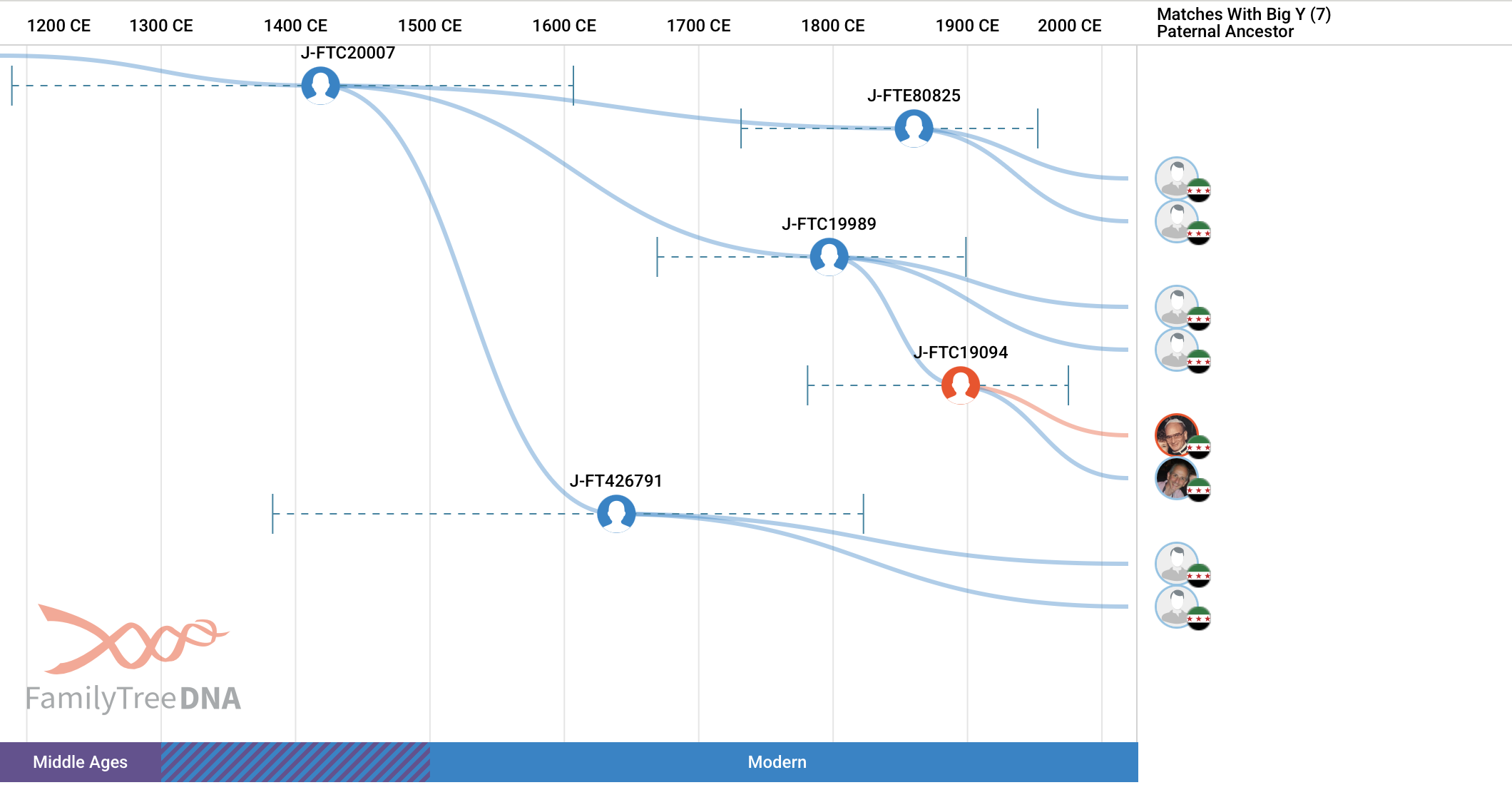
FamilyTreeDNA Big-Y Match Time Tree showing the Abadi paternal line. The branch highlighted in red, J-FTC19094, represents the Y-DNA branch associated with my grandfather Abraham Abadi Balid and his direct paternal descendants. Image: FamilyTreeDNA
Then My Grandfather Appeared in the DNA
This is where the project became personal.
My grandfather was Abraham Abadi Balid.
Based on the relationships of the men who have tested and their positions on the Y-DNA tree, I believe the mutation defining J-FTC19094 may have arisen with my grandfather Abraham, or very near his generation.
I want to be careful about the wording here.
FamilyTreeDNA has not identified Abraham by name as the man in whom this mutation occurred. DNA cannot simply label a branch with the name of an ancestor.
This is my working genealogical hypothesis, based on the combination of our known family relationships and the genetic evidence currently available.
Two relatives who descend through another part of the family remain positioned under the ancestral branch J-FTC19989, while my father’s line falls downstream at J-FTC19094.
That branching pattern is consistent with the possibility that the mutation defining FTC19094 appeared with Abraham and was then inherited by his male-line descendants.
When I contacted FamilyTreeDNA to discuss this, they could not confirm that Abraham himself was the man in whom the mutation first occurred. Additional testing from strategically selected descendants would be needed to narrow the question further.
And technically, we could pursue that.
But for my current research goal, I do not think we need to.
The existing evidence allows me to treat Abraham as the leading hypothesis for where this particular branch began while remaining open to revising that conclusion if future testing provides better evidence.
That is genealogy.
We work with the best evidence available today while leaving room for tomorrow's evidence to teach us something new.
Why Doesn't the Date on the Time Tree Match Exactly?
This was one of my questions for FamilyTreeDNA.
If the genealogical evidence suggests a particular branch may correspond to an ancestor whose birth date we know, why might FamilyTreeDNA’s Time Tree place the branch somewhat earlier or later?
The answer lies in how genetic dating works.
The dates displayed on the Time Tree are statistical estimates based on mutation rates and other available genetic, genealogical, and ancient-DNA information. The date displayed is not meant to say, “This mutation happened in this exact man in this exact year.”
There is a range of uncertainty around it.
As additional people test, FamilyTreeDNA may obtain information that changes the estimated age of a branch. New tests can also cause existing branches to divide into smaller, more recent branches.
In other words, the Y-DNA tree is not finished.
It is growing.
And That Is Why More Abadi Men Matter
This is perhaps the most important part of the project.
Every additional Big Y tester has the potential to add another piece to the Abadi paternal tree.
Imagine that an Abadi man whose exact relationship to my branch is unknown takes the Big Y test.
He might remain at J-FTC20007.
He might join one of the existing downstream branches.
He might share previously private mutations with another tester, causing FamilyTreeDNA to identify an entirely new branch.
Or his result might help us determine where two documented Abadi family lines separated generations ago.
That is why I am not simply looking for “DNA matches.”
I am trying to build the genetic family tree of the Abadi paternal line.
And to do that, the most valuable testers are not necessarily the closest relatives.
Sometimes a carefully chosen distant Abadi cousin can tell us far more.
What I Hope We Can Eventually Learn
My goal is not to test every Abadi man I can find.
It is to test strategically.
I want to identify men descending through different documented Abadi paternal branches and compare where each one falls on the Y-DNA tree.
With enough strategically placed testers, we may eventually be able to associate certain genetic branches with specific documented ancestors.
We may discover which modern Abadi families share a relatively recent paternal ancestor.
We may connect branches whose documentary records have been lost.
We may discover that some Abadi lines separated much earlier than family tradition suggested.
And we may encounter surprises.
That is part of the research.
What Y-DNA Cannot Tell Us
There is another side of this that is equally important.
DNA is powerful, but it does not write history for us.
A haplogroup cannot tell me that an ancestor was a rabbi, merchant, or scholar. It cannot prove that a medieval ancestor lived in Aleppo simply because his descendants later did. It cannot tell me whether he identified as Sephardic, Musta'arabi, Syrian, or something else.
Those conclusions require historical and genealogical evidence.
This is why I am cautious about attaching specific historical events to estimated Y-DNA dates.
For example, the estimated common ancestor of J-FTC20007 lived around a period of enormous change in the region. Aleppo had been devastated by Timur, or Tamerlane, in 1400 and later returned to Mamluk control before becoming part of the Ottoman Empire in 1516.
It is fascinating historical context.
But I cannot say that our J-FTC20007 ancestor was in Aleppo during those events, survived Tamerlane's attack, or even knew Aleppo.
Not yet.
Perhaps someday documentary evidence and DNA will allow us to make a stronger connection.
For now, history provides context. DNA provides a paternal lineage. Genealogy is what attempts to connect the two.
A Family Tree Written in DNA
When I first began researching my family, I never imagined that one day I would be looking at a chart where a mutation could potentially represent my grandfather.
There is something extraordinary about that.
A tiny change occurred somewhere on one man's Y chromosome. He could not see it. He did not know it was there.
But he passed it to his son.
His son passed it to another son.
And generation after generation carried it forward.
Today, that mutation can become another form of genealogical evidence.
Documents give me names.
Photographs give me faces.
Family stories give me memories.
And Y-DNA gives me a biological thread connecting one father to another across generations.
The Abadi Y-DNA tree is still incomplete.
In fact, I hope it is.
Because every new branch means there is still another story waiting to be discovered.
FamilyTreeDNA, Introduction to the Big Y-700 Test.
FamilyTreeDNA, Big Y Block Tree Introduction.
FamilyTreeDNA, Scientific Details: A Deeper Dive Into Age Estimates, September 19, 2022.
FamilyTreeDNA, Big Y-700: Explore Your Father’s Line in Greater Depth.
FamilyTreeDNA Discover™, Y-DNA Time Tree for the J-FTC20007 Abadi paternal lineage, accessed August 2026. Screenshot and research notes in the possession of the author.
