
For years, I knew my great-grandmother as Rachel Shmalo Douek. I knew the names of her children, but I did not know the surname she was born with. Finding it meant following her daughters across countries, looking closely at family photographs, listening to relatives, and studying my mother’s DNA matches.
Rachel and my great-grandfather Rafael Shmalo Douek had seven known children: Shabetai, Simha, Sabut, Sarah, Latife—also called Lottie—Nahmo, known as Naomi, and Bahie, my maternal grandmother.
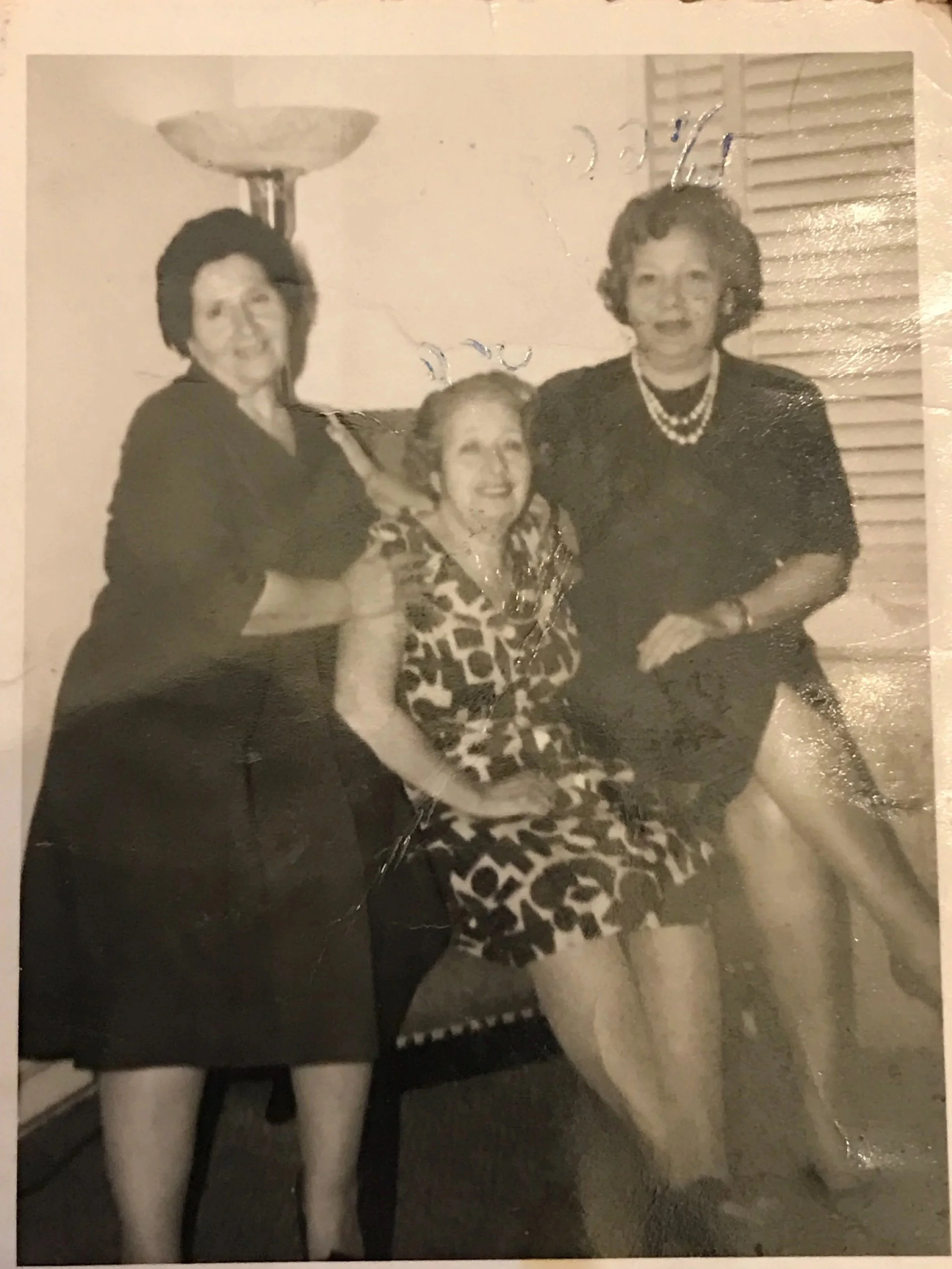
Three Sisters Shmalo Douek
Left to right: Bahie, Sarah, and Latife.
Photograph from the family collection of Jacqueline Abadi Safdieh.
Bahie, the youngest, was born around 1908. According to our family, Rachel died while Bahie was still a child, and her older sister Sabut helped raise her. Bahie grew up alongside Sabut’s son, Ezra Shamosh, who was only three years younger.
I was fortunate to know my grandmother. But by the time I began asking questions about her ancestors, she had been gone for about forty years. There was so much I wished I had asked her.
A book and a shoebox of photographs
When my mother turned eighty, I took her to Israel to celebrate with her siblings. During that trip, I met cousins, asked questions, and wrote down surnames people said were connected to our family. One of those names was Serouya.
At my aunt Susan’s house, I was shown Le Kedoshim Asher baAretz, by Hacham David Laniado. The family told me that Bahie had ordered a copy for each of her children before she died. They believed our relatives appeared in its pages, although no one could tell me exactly who they were. Each child eventually received a copy, including my mother. After we returned home, I made sure her copy became part of my family-history collection.
I also received a shoebox of photographs that had belonged to Bahie. To me, it was a treasure. There were pictures of her with her sisters in New York and with relatives visiting Israel. My mother helped identify many of the people, but a few remained uncertain.
There were no photographs of Rachel or Rafael. I had no idea what either of them looked like.
One picture, however, would turn out to hold an important clue.
The woman holding my grandmother’s hand
I sent several photographs to the Sephardic Heritage Museum, hoping someone might recognize the people in them. The pictures were not posted, but I received a reply about one showing four women and a boy.
My grandmother was sitting on the far right, holding another woman’s hand. I had been told that woman was her sister Sabut. A descendant of the woman, whom I will call R.S., identified her as Sabouth Serouya, wife of Saul Safdieh. He recognized her through his own family and said she was a cousin of the other women, although he did not know the exact relationship.[1]
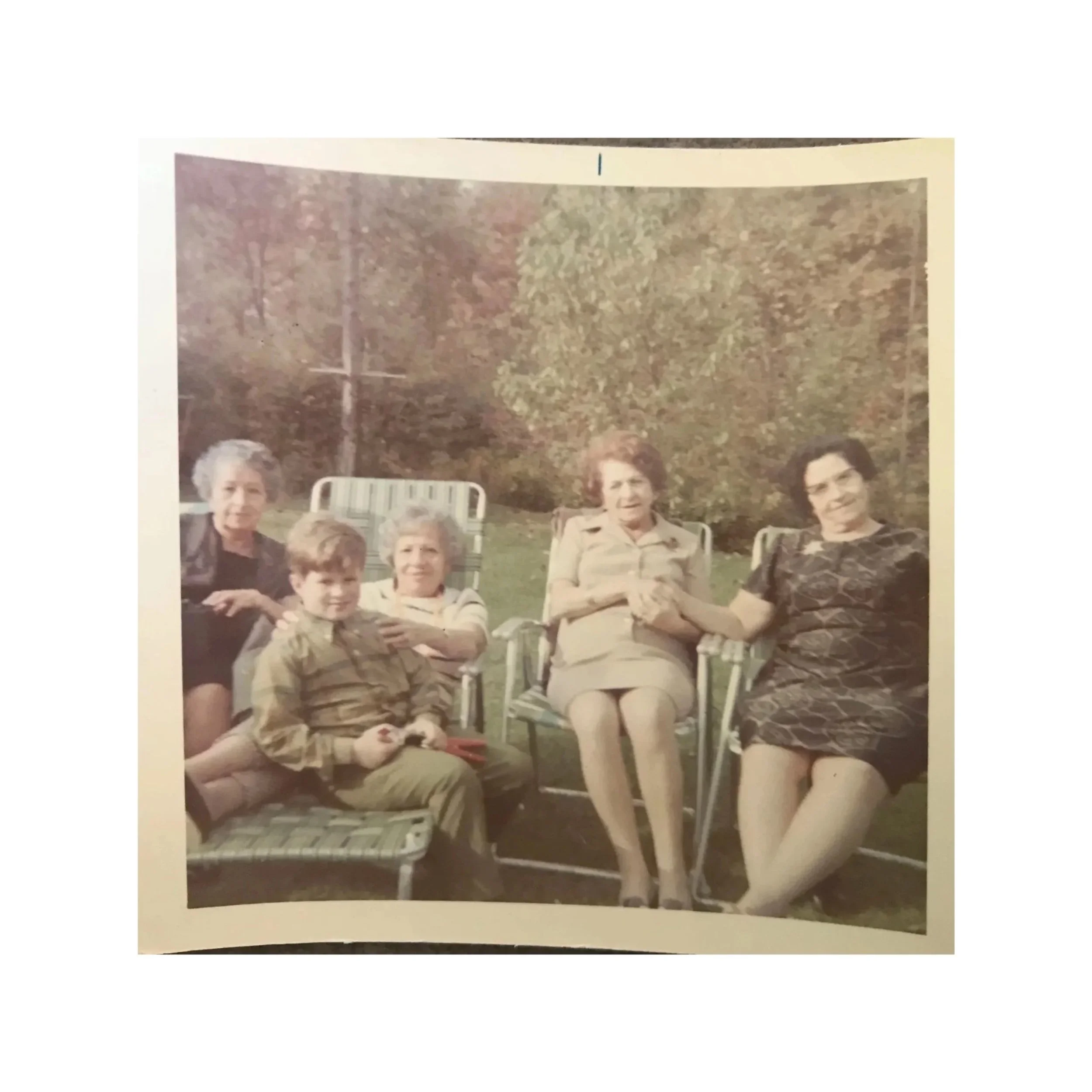
Shmalo Douek - Serouya Cousins
Left to right: Sarah, Latife, their cousin Sabouth Serouya, and Bahie; the boy remains unidentified.
Photograph from the family collection of Jacqueline Abadi Safdieh.
The Safdieh connections were already familiar. My grandmother Bahie had married Itzhak Safdieh, and her sister Sarah had married Abraham Safdieh, Saul’s brother.
But Sabouth’s birth surname caught my attention. Serouya was one of the names I had written down in Israel. Could this photograph help me find Rachel’s family?
Following the daughters
Three of Bahie’s sisters had immigrated to the United States in the early twentieth century. Following their lives meant searching under different spellings of their given names and surnames.
These were not unfamiliar people whose identities I was trying to guess. They were my grandmother’s sisters, people my mother knew. The challenge was finding how their names had been recorded.
Our family used compound surnames such as Shmalo Douek and Abadi Balid. In American records, my great-aunts might appear under Shmalo or Dweck, with several variations in spelling. The Serouya family also used the name Taraman. Depending on the person and the document, the surname might appear as Serouya, Seruya, Serouya Taraman, or simply Taraman.
Recognizing these names helped me follow the family through the records.
One important document was Nahmo’s marriage record. She married Isaac Mizrahi in Manhattan on 1 April 1921. The certificate names her father as Rafael and her mother as Rachel, followed by a handwritten version of Rachel’s birth surname.[2] Read alongside the other family information and Serouya connections I was gathering, it helped me put the pieces together.
Rachel’s maiden name was Serouya.
Sarah’s passenger manifest provided another clue. She traveled aboard the Chicago, which sailed from Havre on 25 May 1914 and arrived in New York on 3 June. Her entry lists her mother as the relative left behind, suggesting that Rachel was still living at the time of Sarah’s departure.[3] I have not established Rachel’s exact death date.
I also located Sarah in New Jersey’s 1982 death index. It records her death on 2 July 1982, at age eighty-six.[4] I do not yet have her death certificate, or those of her sisters Nahmo and Latife. The index helps document Sarah’s life, but it does not name her parents.
Finding the Serouya and Mosseri connections
Meanwhile, I was studying my mother’s DNA matches, building research trees, and comparing shared chromosome segments when available.
Several matches connected us to descendants of Samuel Serouya and Sabut Mosseri. My research led me to identify them as Rachel’s parents. I also traced matches through descendants of a brother of Sabut, extending the connections into the Mosseri family.[5]
Marriage transcriptions from Aleppo record Samuel—Shmuel, son of Yitzhak—marrying Sabut, also recorded as Sabatia, on 22 June 1864, or 18 Sivan 5624. The marriage information identifies her as a daughter of Ezra Mosseri.[6]
Rachel named one of her daughters Sabut. In a family where children were often named after grandparents, that was another meaningful clue.
The records also introduced a name I am still trying to understand: Nusser, sometimes written Nesser.
Morris Serouya, Rachel’s brother, died in Brooklyn on 25 January 1936. His death certificate names his father as Samuel Serouya and his mother as Sabut Nusser. It names his wife as Rose Khabaz and identifies his mother-in-law, Rena Khabbaz, as the informant.[7]
Nusser was therefore not just a name appearing in someone else’s family tree. It was written on a family document. The marriage transcription records Mosseri, while Morris’s death certificate records Nusser. I have kept both in my research rather than assuming I know why the names differ.
My mother’s DNA connections helped bring these branches together. I used a WATO tree to explore possible relationships and organize the matches, alongside the documentary research and what our family already knew.
DNA was one part of that process. In communities where families married within the same community over generations, relatives can share more than one ancestral line. That makes the family records and the paths connecting each match especially important.[8]
Searching for women in Aleppo’s records
Researching Jewish families from Ottoman-era Aleppo takes patience. The records available online cover scattered years, and information is spread across community registers, manuscripts, and collections.
The JewishGen Aleppo marriage collection draws on surviving records written in Hebrew and Judeo-Arabic. Its introduction explains the stages of translation and transliteration and acknowledges that errors may have entered along the way.[9]
Women have been especially difficult to trace in my research. In some burial entries I examined, a woman was identified through a relative—as someone’s wife, mother, daughter, or sister—without her own name.
That made finding Rachel’s birth surname even more meaningful to me. It gave me a way to follow her own family, beyond the surname she carried after marriage.
A new face in the family
After I shared this story on social media, a granddaughter of Shabetai contacted me from Israel. She was very moved by the article and sent me a photograph of her grandfather, my grandmother Bahie’s brother.
It was the first time I could put a face to his name.
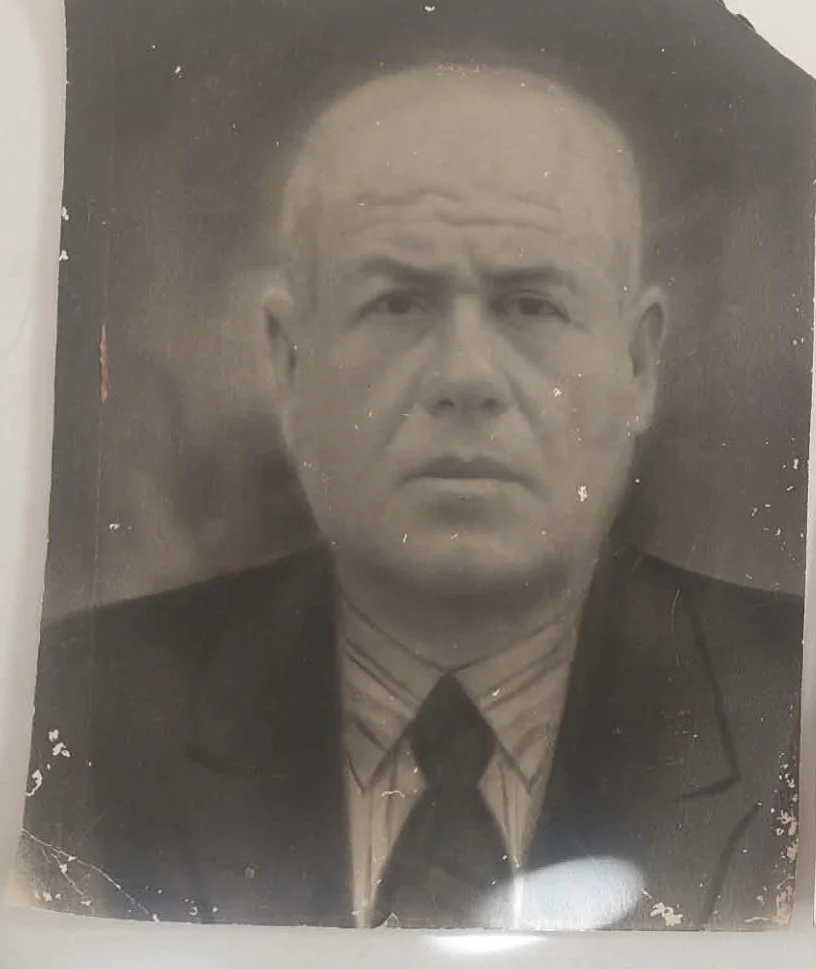
Shabetai Shmalo Douek
Photograph courtesy of Nava Melman, Shabetai’s granddaughter and my second cousin.
I also have a photograph of Shabetai’s wife, Adina “Latife” Gindi, and their children that I found in my mother’s drawer.
I still have no photograph of Rachel or Rafael, and I do not know what they looked like. Seeing their children makes me wonder which features they might have shared.
What began with a missing surname has brought me records, photographs, and new connections with relatives. Rachel is no longer only a name I knew through my grandmother. I can now tell more of her story as Rachel Serouya, wife of Rafael Shmalo Douek, mother of seven children, and my great-grandmother.
There is still more to learn. I hope sharing her story will help us find it together.
Sources and research notes
Family photograph and identification: photograph from Bahie Shmalo Douek’s collection; identifications supplied by my mother and correspondence with R.S. following my inquiry to the Sephardic Heritage Museum. Photograph and correspondence in my private family collection.
Nahmo and Isaac’s marriage: City of New York, Department of Health, Manhattan marriage certificate no. 9421, 1 April 1921, Isaac Mizrahi and Nahmo/Naomi Douek; two-page record, digital images in my collection. The mother’s handwritten surname should be read from the image rather than silently standardized in a transcription.
Sarah’s passenger manifest: S.S. Chicago, departing Havre 25 May 1914, arriving New York 3 June 1914, manifest sheet marked 6, Sarah Shmalo entry; digital image 007678294_00362-s.jpg, in my collection.
Sarah’s death index: New Jersey Department of Health, Bureau of Vital Statistics, Annual Death Index, 1982, p. 1257, entry for Sarah Safdieh, certificate 035240, death 2 July 1982, age 86. This is an index entry, not the death certificate.
Family relationships and DNA research: my family interviews, research trees, my mother’s DNA-match information, and WATO research chart. These are working research materials in my private collection. Names and individual DNA details of living matches are not reproduced here.
Samuel and Sabut’s marriage: Israel Genealogy Research Association, All Israel Database, Marriages 1847–1934 Syria, entry headed “Shmuel Ben, son of Yitzhak, husband of Sabatia”; marriage 22 June 1864 / 18 Sivan 5624; document 10659, IGRA no. 1317; source identified as Benayahu Library 43738, National Library of Israel. Saved database transcription and related marriage information in my collection; this is a transcription, not an image of the original register.
Morris Serouya’s death: City of New York, Department of Health, Brooklyn death certificate no. 2162, 25 January 1936, Morris Serouya; two-page record, digital images in my collection.
DNA interpretation: Katy Rowe-Schurwanz, “How to Interpret DNA Matches,” FamilyTreeDNA. For the scope and limitations of WATO, see DNA Painter’s WATO FAQ.
Aleppo records: Sarina Roffé, “Marriages in Aleppo, Syria,” JewishGen, particularly the introduction, transliteration discussion, and list of manuscript sources.
